


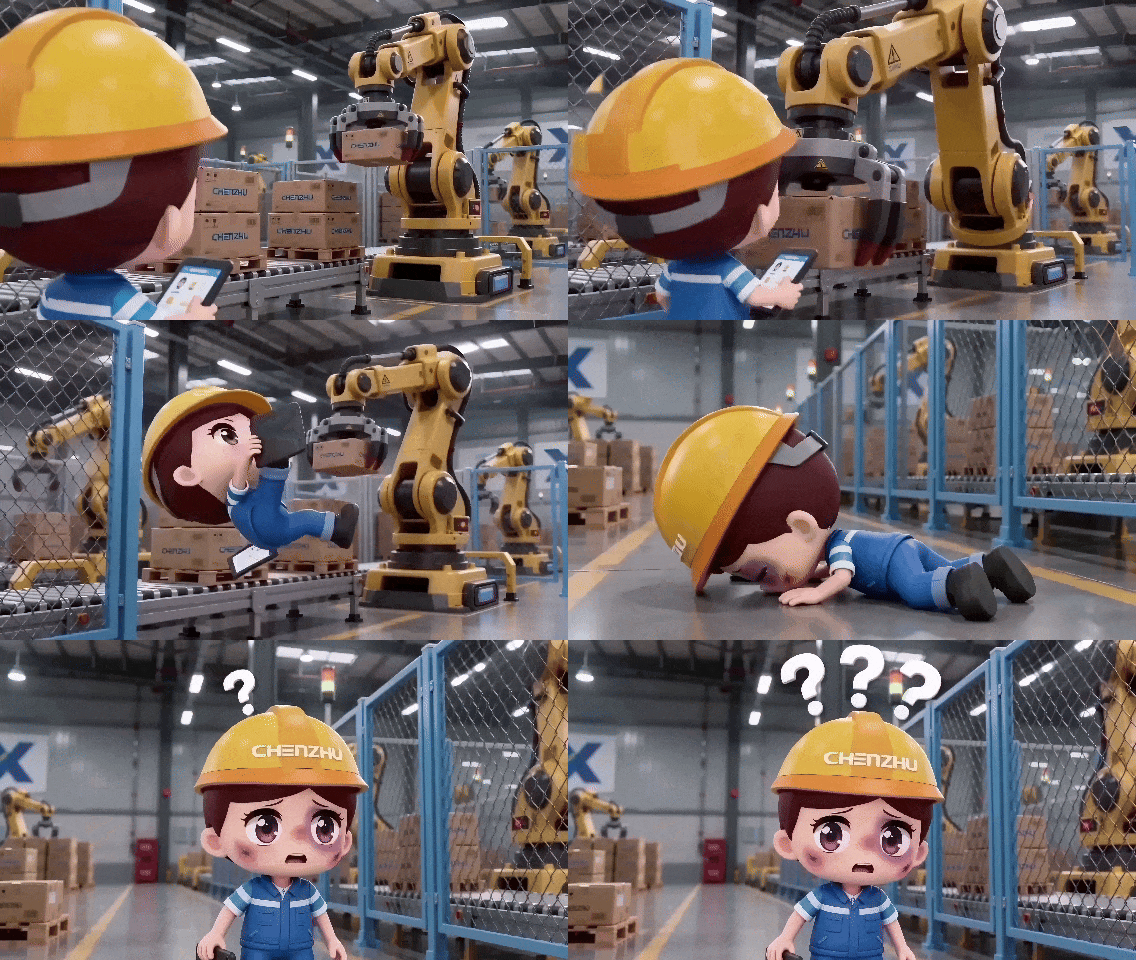
Shanghai Palletizing robots can operate 24/7 tirelessly with high precision and efficiency. Yet professionals in the automation industry know the flip side: the more capable a robot is, the greater the danger if it malfunctions. Its immense force can cause instant injury to anyone in close proximity. In accordance with domestic and international standards and specifications including GB/T 34038-2017, ISO 12100 and ISO 13849-1, safety protection for palletizing robots must run through the entire life cycle, with every link—from risk assessment to hardware configuration—being critical.
01 Core Compliance and Safety Requirements
Pursuant to GB/T 34038-2017, safety protection for robotic palletizing shall take life-cycle risk control as the core and strictly adhere to national and regional standards and specifications: - European Union: Machinery Directive 2006/42/EC. Core safety protection complies with ISO 10218-2:2025 *Safety Requirements for Industrial Robots*, adopting a dual-channel safety redundancy design to ensure system reliability through redundant control. - China: Implements the requirements of GB/T 34038-2017 *General Technical Conditions for Palletizing Robots* and GB 11291.2-2013 *Robots and robotic devices - Safety requirements for industrial robots - Part 2: Robot systems and integration*, with GB/T 5226.1 *Mechanical and electrical safety* as the core standard. Core components such as emergency stop devices and safety protection systems must meet mandatory specifications. The safety control logic shall meet or exceed the ISO 13849-1 PLd standard, with risk level assessment and safety loop verification implemented throughout the entire process.
02 Suggestions for Compliance Implementation
Conduct a full-life-cycle risk assessment in accordance with ISO 12100 *Machinery safety - Risk assessment*. For typical hazardous scenarios during palletizing robot operation (e.g., crushing, shearing, mechanical collision, accidental start-up), conduct a comprehensive identification of hazard sources, risk classification and formulation of control measures to ensure that protective measures accurately match on-site risk levels.
03 Robotic Palletizing Safety Solution
1. Intrinsic Safety and Physical Isolation
I. The height of the conveying roller bed at the loading port shall be ≥1000mm to prevent personnel from easily crossing the hazardous area (compliant with EN 619:2022).
II. A 2200mm-high mechanical protective fence shall be installed in the non-operating area of the palletizing zone, with a mesh size of 20×100mm and wire diameter of 3mm. The safety distance between the fence and the nearest point of the robot's motion trajectory shall be ≥400mm (compliant with ISO 14120:2015 and ISO 13857:2019).
III. The safety door is integrated with a mechanically guided bolt with LOTO lockout points. Mechanical padlocks must be applied before personnel enter the hazardous area to achieve physical locking of safety functions (compliant with ISO 14118:2017).
2. Intelligent Sensing and Monitoring
I. A safety light curtain with Muting function shall be configured at the loading port (protection height: 1200mm, resolution: 30mm), which can accurately distinguish between materials and human bodies. Materials pass through normally, and a Class 0 stop is triggered immediately if the curtain is blocked by personnel (compliant with IEC 62046:2018).
II. A safety light curtain shall be installed vertically at the unloading port (lowest optical axis ≤300mm, highest optical axis ≥900mm, actual protection height: 1500mm, resolution: 30mm). The safety distance from the robot's trajectory shall be ≥1200mm to prevent personnel from crawling into the hazardous area (compliant with ISO 13855:2010).
III. Three sets of safety radar presence detection devices shall be arranged in the operation area to achieve full coverage without blind spots. The equipment can only be restarted when no personnel are detected by both radars and light curtains, and after an external manual reset (compliant with ISO 10218-2).
IV. The fence-hinged safety door is equipped with a safety interlock device with a locking function. When the unlock button is triggered, the robot and roller bed immediately execute a Class 0 stop before the door can be opened; the equipment can only be restarted after the safety door is closed and locked, and an external manual reset is performed (compliant with ISO 14119:2024).
3. Emergency Response and Misoperation Prevention
I. Emergency stop buttons shall be installed at key positions such as safety doors and unloading port operation boxes; pressing the button triggers an immediate Class 0 safety stop (compliant with ISO 13850:2015).
II. A main circuit load switch shall be installed in the electric control cabinet to realize the power supply LOTO function, serving as supplementary physical isolation protection during equipment maintenance (compliant with IEC 60204-1:2016 and AMD1:2021 ED6).
III. All safety interlocks, radars, light curtains, emergency stop devices and other components are integrated into Chenzhu's CZSC Safety Controller to realize unified management and linked response of safety signals. The safety stop function meets Cat.3 and PLd levels (compliant with ISO 13849-1:2023).
04 Operation and Management Assurance
1. Personnel Training:
Establish a safety operation training system for robotic palletizing, covering equipment operation, emergency stop procedures, emergency disposal, LOTO lockout/tagout specifications, etc. Operators may only take up their posts after passing the assessment.
2. Equipment Maintenance:
Formulate a full-life-cycle equipment maintenance plan. Regularly inspect the braking performance of robot joints and the tightness of hydraulic/pneumatic systems; calibrate the sensitivity of detection devices such as safety light curtains, radars and sensors; and check the operating status of core components such as safety controllers and interlock devices.
3. Risk Warning:
Post prominent safety warning signs for mechanical injury and misstart prevention in hazardous areas such as protective fences, safety doors and loading/unloading ports.
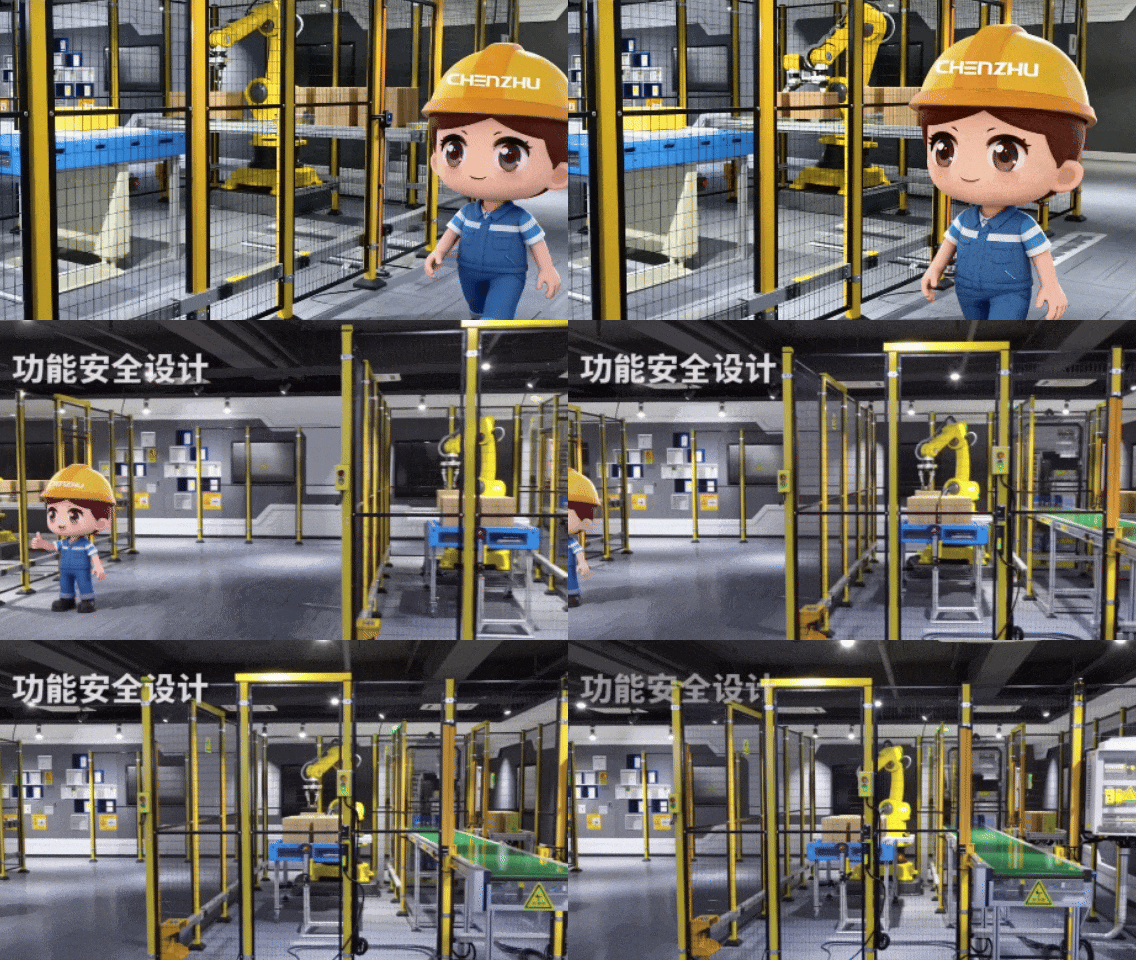
The intelligent development of industrial automation is not about making machines operate faster, but about making them know when to stop. In the field of factory automation, Chenzhu provides a comprehensive product solution for mechanical safety control systems, helping mechanical equipment eliminate or reduce risks and enter and maintain a safe state when faults occur or specific conditions are triggered.
The CZSC Compact Series is a compact, fully functional and flexibly configurable in-cabinet control module. Through free combination of modules, complex safety control systems can be quickly built. It is widely used in small and medium-sized single machines and assembly lines in various industries including machine tools, packaging, rubber and plastic, electronics, new energy and robot workstations, meeting the diverse on-site safety control requirements.
- Safety Performance: Designed in accordance with IEC 61508, meeting the industry standards of PLe Cat.4 and SIL3, and complying with all TÜV certification requirements (currently in the certification process), eliminating users' concerns about export compliance.
- Product Features: Supports module expansion via the backplane bus; compatible with all mainstream fieldbus communications and speed/frequency input; the real-time operating status can be viewed on the OLED screen and indicator lights on the module, meeting users' demands for functionality and ease of use.
- Quality Assurance: Manufactured in a digital factory in accordance with the quality management system; all models are coated with printed circuit boards following the G3 anti-corrosion standard; a 5-year warranty is provided, along with rapid response and comprehensive services, giving users extra peace of mind.
Product Features
1. A single module is equipped with multiple groups of safety I/O points.
2. Equipped with a Type-C configuration port and the new generation Safconfig configuration software.
3. Up to 4 modules can be expanded via the backplane.
4. Supports input speed monitoring of frequency signals.
5. Module operation information can be viewed via the OLED screen.
6. Supports various fieldbus communication protocols.
The CZSC Compact Series includes four main models: CPU module, extended I/O module, extended frequency module and gateway module.
Founded in 2002, Shanghai CHENZHU Instrument Co., Ltd. evolved from the R&D team of the "Intrinsically Safe Automatic Control System Associated Equipment (Safety Barrier) Technology Research and Industrialization" project—a Ninth Five-Year Key Scientific and Technological Research Program of the Shanghai Institute of Industrial Automation Instruments (SIPAI). The company specializes in the R&D, manufacturing, sales and service of safety field products. Its main products include safety relays, safety controllers, isolated safety barriers, signal isolators, surge protectors, HART multiplexers, etc., which are widely used in petroleum, natural gas, chemical industry, metallurgy, pharmaceutical, machinery, building materials, robotics, automobile manufacturing, new energy and other industries. CHENZHU provides a full range of high-reliability safety guarantee solutions, effectively responding to interference and risks in complex industrial environments and helping to achieve safe, stable and efficient continuous production. CHENZHU has successively won numerous product awards including the National Key New Product Award, China Machinery Industry Science and Technology Progress Award and Shanghai Science and Technology Progress Award; it has also been awarded honorary titles such as the National Specialized, Sophisticated, Unique and Novel "Little Giant" Enterprise, "Shanghai Brand" Certified Enterprise and Shanghai May 1st Labor Certificate Enterprise. CHENZHU focuses on the key technologies of the intelligent manufacturing and instrument and meter industry. All products are independently R&D and produced, with a complete reserve of 100% domestically manufactured products; its laboratory has obtained CNAS certification. The company has built an automated flexible production line with an annual capacity of up to 3 million units, realizing full traceability of production processes and quality information to ensure on-time delivery with high quality and quantity.